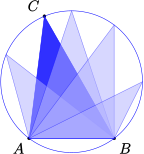
If we know two angles and one side of a triangle, we can use the Law of Sines to solve the triangle. We can also use the Law of Sines when we know two sides and the angle opposite one of them. But the Law of Sines is not helpful for the problem that opened this chapter, finding the distance from Avery to Clio. In this case we know two sides of the triangle, \(a\) and \(c\text{,}\) and the included angle, \(B\text{.}\)
To solve a triangle when we know two sides and the included angle, we will need a generalization of the Pythagorean theorem known as the Law of Cosines.
In a right triangle, with \(C = 90\degree\text{,}\) the Pythagorean theorem tells us that
\begin{equation*}
c^{2} = a^{2} + b^{2}
\end{equation*}
If we allow angle \(C\) to vary, but keep \(a\) and \(b\) the same length, the side \(c\) will grow or shrink, depending on whether we increase or decrease the angle \(C\text{,}\) as shown below.
The Pythagorean theorem is actually a special case of a more general law that applies to all triangles, no matter what the size of angle \(C\text{.}\) The equation relating the three sides of a triangle is
\begin{equation*}
c^{2} = a^{2} + b^{2} - 2ab \cos (C)
\end{equation*}
You can see that when \(C\) is a right angle, \(\cos 90\degree = 0\text{,}\) so the equation reduces to the Pythagorean theorem.
We can write similar equations involving the angles or \(A\) or \(B\text{.}\) The three equations are all versions of the Law of Cosines.
Law of Cosines.
If the angles of a triangle are \(A, B\text{,}\) and \(C\text{,}\) and the opposite sides are respectively \(a, b,\) and \(c\text{,}\) then
\begin{gather*}
\blert{a^{2} = b^{2} + c^{2} - 2bc \cos (A)}\\
\blert{b^{2} = a^{2} + c^{2} - 2ac \cos (B)}\\
\blert{c^{2} = a^{2} + b^{2} - 2ab \cos (C)}
\end{gather*}
Subsection Finding an Angle
We can also use the Law of Cosines to find an angle when we know all three sides of a triangle. Pay close attention to the algebraic steps used to solve the equation in the next example.
Example 3.44.
In the triangle at right, \(a = 6,~ b = 7\text{,}\) and \(c = 11\text{.}\) Find angle \(C\text{.}\)
Solution.
We choose the version of the Law of Cosines that uses angle \(C\text{.}\)
\begin{align*}
c^{2} \amp = a^{2} + b^{2} - 2ab \cos (C) \amp\amp \blert{\text{Substitute the known values.}}\\
11^{2} \amp = 6^{2} + 7^{2} - 2(6)(7) \cos (C) \amp\amp \blert{\text{Simplify each side.}}\\
121 \amp = 36 + 49 - 84 \cos (C) \amp\amp \blert{\text{Isolate the cosine term.}}\\
36 \amp = -84 \cos (C) \amp\amp \blert{\text{Solve for cos (C).}}\\
\dfrac{-3}{7} \amp = \cos (C) \amp\amp \blert{\text{Solve for C.}}\\
C \amp = \cos^{-1} \left(\dfrac{-3}{7}\right) = 115.4\degree
\end{align*}
Angle \(C\) is about \(115.4\degree\text{.}\)
Checkpoint 3.45.
In \(\triangle ABC\text{,}\) \(~a = 5.3,~b = 4.7\text{,}\) and \(~c = 6.1\text{.}\) Find angle \(B\text{,}\) and round your answer to two decimal places.
Answer.
Substitute the known values into the Law of Cosines to get
\begin{equation*}
4.7^2 = 5.3^2 + 6.1^2 - 2(5.3)(6.1)\cos(B)
\end{equation*}
from which we find \(\cos(B) = 0.6683\text{,}\) so
\begin{equation*}
B = \cos^{-1}(0.6683) = 48.07\degree\text{.}
\end{equation*}
Once we have calculated one of the angles in a triangle, we can use either the Law of Sines or the Law of Cosines to find a second angle. Here is how we would use the Law of Sines to find angle \(A\) in the previous Example.
\begin{align*}
\dfrac{\sin (A)}{a} \amp = \dfrac{\sin (C)}{c} \amp\amp \blert{\text{Substitute the known values.}}\\
\dfrac{\sin (A)}{6} \amp = \dfrac{\sin (115.4\degree)}{11} \amp\amp \blert{\text{Solve for} \sin A.}\\
\sin (A) \amp = 6 \cdot \dfrac{\sin (115.4\degree)}{11} \approx 0.4928
\end{align*}
Thus, \(A = \sin^{-1}(0.4928) = 29.5\degree\text{.}\) There are two angles with sine \(29.5\degree\text{,}\) but we know that \(A\) is an acute angle because it is opposite the shortest side of the triangle. Finally,
\begin{equation*}
B = 180\degree - (A + C) \approx 35.1\degree
\end{equation*}
Alternatively, we can use the Law of Cosines to find angle \(A\text{.}\)
\begin{align*}
a^{2} \amp = b^{2} + c^{2} - 2bc \cos (A) \amp\amp \blert{\text{Substitute the known values.}}\\
6^{2} \amp = 7^{2} + 11^{2} - 2(7)(11) \cos (A) \amp\amp \blert{\text{Simplify each side.}}\\
36 \amp = 49 + 121 - 154 \cos (A) \amp\amp \blert{\text{Isolate the cosine term.}}\\
-134 \amp = -154 \cos (A) \amp\amp \blert{\text{Solve for} \cos (A).}\\
\dfrac{67}{77} \amp = \cos (A) \amp\amp \blert{\text{Solve for A.}}\\
A \amp = \cos^{-1} \left(\dfrac{67}{77}\right) = 29.5\degree
\end{align*}
Subsection Which Law to Use
How can we decide which law, the Law of Sines or the Law of Cosines, is appropriate for a given problem?
If we are solving a right triangle, we don’t need the Laws of Sines and Cosines; all we need are the definitions of the trigonometric ratios.
But for oblique triangles, we can identify the following cases:
How to Solve an Oblique Triangle.
| If we know: |
We can use: |
| 1. One side and two angles (SAA) |
1. Law of Sines, to find another side |
2. Two sides and the included angle
(SAS) |
2. Law of Cosines, to find the third
side |
| 3. Three sides (SSS) |
3. Law of Cosines, to find an angle |
4. Two sides and the angle opposite
one of them (SSA, the ambiguous
case) |
4. Law of Sines, to find another angle,
or Law of Cosines, to find another
side |
Example 3.49.
In the triangle at right, which law should you use to find \(\angle B\text{?}\)
Solution.
We know two sides of the triangle and the angle opposite one of them. We can use the Law of Sines to find \(\angle B\text{.}\)
\begin{align*}
\dfrac{\sin (B)}{6} \amp = \dfrac{\sin (40\degree)}{10}\\
\sin (B) \amp = 0.3857
\end{align*}
There are two angles between \(0\degree\) and \(180\degree\) with sine \(0.3857\text{,}\) namely \(22.7\degree\) and its supplement, \(157.3\degree\text{.}\) Both of these angles might produce a solution. However, in this case we notice that because \(a \gt b\text{,}\) angle \(B\) must be acute.
Checkpoint 3.50.
In the triangle at right, which part of the triangle can you find, and which law should you use?
Answer.
We know two sides and the included angle, so we can find side \(c\) using the Law of Cosines.
In the previous Example we used the Law of Sines to find an angle. Because there are always two angles with a given sine, we should check whether both possible angles result in a triangle. But here is another approach: We can apply the Law of Cosines to find the third side first. With that method, we’ll need the quadratic formula.
Quadratic Formula.
The solutions of the quadratic equation \(ax^{2} + bx + c = 0,~~a \not= 0,\) are given by
\begin{equation*}
\blert{x = \dfrac{-b \pm \sqrt{b^{2} - 4ac}}{2a}}
\end{equation*}
Example 3.51.
In the triangle at right, use the Law of Cosines to find \(c\text{.}\)
Solution.
We will use the Law of Cosines with angle \(A\text{.}\)
\begin{align*}
a^2 \amp = b^2 + c^2 -2bc \cos (A)\\
10^{2} \amp = 6^{2} + c^{2} - 2(6)c \cos (40\degree)\\
100 \amp = 36 + c^2 - 12 (0.7660) c
\end{align*}
This is a quadratic equation in \(c\text{,}\) so we rearrange the terms into standard form.
\begin{align*}
c^{2} - 12(0.7660)c - 64 \amp = 0\\
c^{2} - 9.1925c - 64 \amp = 0
\end{align*}
Now we can solve for \(c\) using the quadratic formula.
\begin{equation*}
c = \dfrac{9.1925 \pm \sqrt{9.1925^2 - 4(1)(-64)}}{2(1)}
\end{equation*}
There are two solutions, \(13.8\) and \(-4.6\text{.}\) We can ignore the negative solution, so \(c = 13.8\text{.}\)
Subsection Using the Law of Cosines for the Ambiguous Case
In Section 3.2 we encountered the ambiguous case:
If we know two sides \(a\) and \(b\) of a triangle and the acute angle \(\alpha\) opposite one of them, there may be one solution, two solutions, or no solution, depending on the size of \(a\) in relation to \(b\) and \(\alpha\text{,}\) as shown below.
The Ambiguous Case.
-
No solution: \(a \lt b \sin (\alpha)\)
\(\alpha\) is too short to make a triangle.
-
One solution: \(a = b \sin (\alpha)\)
\(\alpha\) is exactly the right length to make a right triangle.
-
Two solutions: \(b \sin (\alpha) \lt a \lt b\)
-
One solution: \(a \gt b\)
To discover which case applies (no triangle, one triangle, or two triangles), we can begin by using the Law of Cosines to find the third side. As we saw in the previous Example, for this method we need the quadratic formula.
A quadratic equation can have one solution, two solutions, or no solution, depending on the value of the discriminant, \(D=b^{2} - 4ac\text{.}\) (Note that the discriminant is the expression under the radical in the quadratic formula. Perhaps you recall how the discriminant determines the number of solutions, and why.)
If \(~D \gt 0\text{,}\) the equation has two solutions.
If \(~D = 0\text{,}\) the equation has one solution.
If \(~D \lt 0\text{,}\) the equation has no (real) solution.
And the number of solutions determines the number of triangles that fit the given properties.
If the quadratic equation has one positive solution, there is one triangle.
If the quadratic equation has two positive solutions, there are two triangles.
If the quadratic equation has no positive solutions, there is no triangle with the given properties.
Example 3.53.
In \(\triangle ABC,~ B = 14.4\degree,~ a = 8\text{,}\) and \(b = 3\text{.}\) Solve the triangle.
Solution.
We begin by finding the third side of the triangle. Using the Law of Cosines, we have
\begin{align*}
b^{2} \amp = a^{2} + c^{2} - 2ac \cos (B) \amp\amp \blert{\text{Substitute the known values.}}\\
3^{2} \amp = 8^{2} + c^{2} - 2(8)c \cos (14.4\degree) \amp\amp \blert{\text{Simplify.}}\\
9 \amp = 64 + c^{2} - 16c (0.9686) \amp\amp \blert{\text{Write the equation in standard form.}}\\
0 \amp = c^{2}-15.497c + 55 \amp\amp \blert{\text{Apply the quadratic formula.}}
\end{align*}
\begin{align*}
c \amp = \dfrac{15.497 \pm \sqrt{(-15.497)^{2} - 4(1)(55)}}{2(1)} \amp\amp \blert{\text{Simplify.}}\\
\amp = \dfrac{15.497 \pm 4.490}{2} = 5.503~ \text{ or }~ 9.994
\end{align*}
Because there are two positive solutions for side \(c\text{,}\) either \(c = 5.503\) or \(c = 9.994\text{,}\) there are two triangles with the given properties. We apply the Law of Cosines again to find angle \(C\) in each triangle.
For the triangle with \(c = 5.503\text{,}\) we have
\begin{align*}
c^{2} \amp = a^{2} + b^{2} - 2ab \cos (C) \amp\amp \blert{\text{Substitute the known values.}}\\
5.503^{2} \amp = 8^{2} + 3^{2} - 2(8)(3) \cos (C) \amp\amp \blert{\text{Solve for} \cos (C).}\\
\cos (C) \amp = \dfrac{5.503^{2} - 64 - 9}{-48} = 0.8899\\
C \amp = \cos^{-1} (0.8899) = 27.1\degree
\end{align*}
and \(A = 180\degree - (14.4\degree + 27.1\degree) = 138.5\degree\text{.}\)
For the triangle with \(c = 9.994\text{,}\) we have
\begin{align*}
c^{2} \amp = a^{2} + b^{2} - 2ab \cos (C) \amp\amp \blert{\text{Substitute the known values.}}\\
9.994^{2} \amp = 8^{2} + 3^{2} - 2(8)(3) \cos (C) \amp\amp \blert{\text{Solve for} \cos (C).}\\
\cos (C) \amp = \dfrac{9.994^{2} - 64 - 9}{-48} = -0.5600\\
C \amp = \cos^{-1} (-0.5600) = 124.1\degree
\end{align*}
and \(A = 180\degree - (14.4\degree + 124.1\degree) = 41.5\degree\text{.}\)
Both triangles are shown below.
Checkpoint 3.54.
Use the Law of Cosines to find all triangles \(ABC\) with \(A = 48\degree,~ a = 10\text{,}\) and \(b = 15\text{.}\)
Answer.
Using the Law of Cosines to find side \(c\text{,}\) we get the equation
\begin{align*}
a^2 \amp = b^2 + c^2 - 2bc \cos (A)\\
100 \amp = 225 + c^2 - 30c \cos(48\degree)
\end{align*}
Putting this quadratic equation into standard form we get
\begin{equation*}
c^2 - 20.07c + 125 = 0
\end{equation*}
The discriminant is
\begin{equation*}
b^2 - 4ac = 20.07^2 - 4(125) = -97.2
\end{equation*}
Because the discriminant is negative, the equation has no solution, and there is no triangle satisfying the stated conditions.
Review the following skills you will need for this section.
Algebra Refresher 3.55.
Solve each quadratic equation.
\(\displaystyle 2.5x^{2} + 6.2 = 166.2\)
\(\displaystyle 0.8x^{2} - 124 = 376\)
\(\displaystyle 2x(2x - 3) = 208\)
\(\displaystyle 3x(x + 5) = 900\)
\(\displaystyle 2x^{2} - 6x = 233.12\)
\(\displaystyle 0.5x^{2} + 1.5x = 464\)
\(\underline{\qquad\qquad\qquad\qquad}\)
Algebra Refresher Answers
\(\displaystyle \pm 8\)
\(\displaystyle \pm 25\)
\(\displaystyle 8,~ {-6.5}\)
\(\displaystyle 15,~ {-20}\)
\(\displaystyle 12.4,~ {-9.4}\)
\(\displaystyle 29,~ {-32}\)